CDL · School Bus
CDL School Bus Practice Test
The S endorsement: danger zones, loading children and evacuation. You need 80% correct to pass (49 CFR 383.135).
- Free, no account
- Cited to 49 CFR and the CDL manual
- Last checked
Question 1 of 200 right · pass line 16
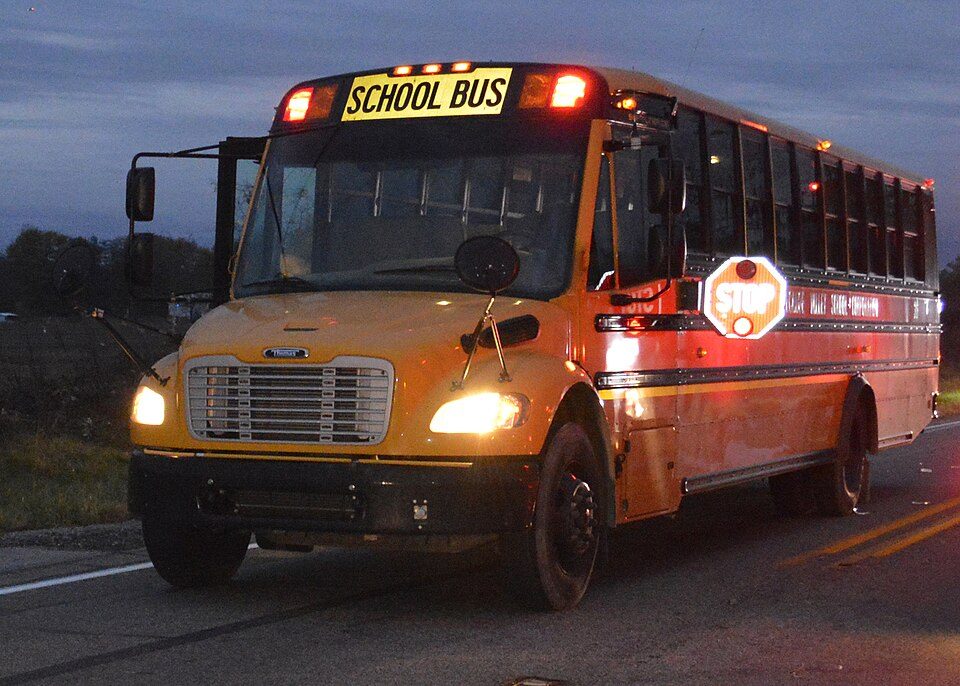
During a pretrip, you operate the stop arm shown. What should you confirm?
What to know for the School Bus test
The school bus test earns the S endorsement, required to drive a school bus. You must hold the passenger endorsement first. The knowledge test covers danger zones, mirrors, loading and unloading children, emergency exits, evacuation and railroad crossings. Passing takes 80 percent correct, and a skills test in a school bus follows.
Last checked against the handbook and 49 CFR on .
What the S endorsement requires
- An applicant must first qualify for the passenger endorsement, then pass the school bus knowledge test and a driving skills test in a school bus of the vehicle group they will drive. 49 CFR 383.123
- The knowledge test covers loading and unloading children, stop signal devices and mirrors, emergency exits and evacuation, railroad-highway crossing laws, and other operating practice. 49 CFR 383.123
- A learner permit holder with the S endorsement may not drive a school bus carrying riders, apart from inspectors, examiners, fellow trainees and the supervising CDL holder. 49 CFR 383.25
Danger zones and mirrors
| Area | Distance |
|---|---|
| In front of the bumper | Up to 30 feet, with the first 12 feet the most dangerous |
| Each side of the bus | 12 feet |
| Behind the rear bumper | 12 feet |
| Left side | Always risky because passing cars use that lane |
| Flat mirrors should show | Roughly 200 feet (four bus lengths) to the rear |
| Rear blind spot | Typically 50 to 150 feet, up to 400 feet on some buses |
| Tail swing | Up to 3 feet |
- Convex mirrors show a wide view but make people and objects look smaller and farther away than they really are. CDL Handbook 10.1
Loading and unloading
- Stop with the front bumper at least 10 feet from waiting students so they must walk toward the bus and into your view. CDL Handbook 10.2
- Shift to Park, or Neutral if there is no Park position, and set the parking brake at every stop. CDL Handbook 10.2
- Switch on the red lights once traffic is a safe distance away, make a last check that every lane has stopped, and only then open the door. CDL Handbook 10.2
- Students who cross the road must walk in front of the bus where you can see them, and children leaving the bus should move at least 10 feet to the side. CDL Handbook 10.2
- If a child is unaccounted for, set the brake, pocket the key and search around and under the bus before moving. CDL Handbook 10.2
- If you miss a student's stop, do not back up; follow your local procedure instead. CDL Handbook 10.2
Emergencies and evacuation
- You must evacuate for a fire or fire threat, a stall at or next to a railroad crossing, a bus position that could worsen, imminent danger of a crash, or a hazardous materials spill that requires leaving fast. CDL Handbook 10.3
- Where possible, give two older, dependable students the job of helping at each emergency exit, and brief everyone on how the exits work. CDL Handbook 10.3
- A safe place is 100 feet or more from the roadway, on the side traffic approaches from. CDL Handbook 10.3
- For a fire, lead students upwind; for a hazardous spill, lead them upwind at least 300 feet. CDL Handbook 10.3
- Do not move an injured student unless life is in immediate danger. CDL Handbook 10.3
Railroad crossings and ABS
- Every bus carrying passengers must halt within 50 feet of the tracks but no nearer than 15 feet, then look and listen. 49 CFR 392.10
- At the stop, put the bus in Park or Neutral, silence the students and radios, open the door and driver window, and look and listen both ways. CDL Handbook 10.4
- With several tracks, make one stop ahead of the first rails, then drive over all of them without shifting. CDL Handbook 10.4
- Make sure the bus fits: add 15 feet to the bus length to find the clear space needed beyond the tracks. CDL Handbook 10.4
- If the bus stalls on the tracks, get everyone out and away from the tracks at an angle toward the train's approach. CDL Handbook 10.4
- If a gate comes down after you start across, keep going and clear the tracks. CDL Handbook 10.4
- Air-brake buses manufactured from 1 March 1998 onward must have ABS, and in an emergency stop you press firmly instead of pumping. CDL Handbook 10.6
School Bus test: common questions
How big are the danger zones around a school bus?
The danger zone extends up to 30 feet in front of the bumper (the first 12 feet being the worst), 12 feet along each side and 12 feet behind. The left side is always risky because of passing traffic. CDL Handbook 10.1
How far from a railroad crossing must a school bus stop?
Between 15 and 50 feet from the nearest rail, at the spot with the best view. Federal rules require every bus carrying passengers to stop, look and listen before crossing, unless an exception such as a green signal or officer applies. 49 CFR 392.10
When must a school bus driver evacuate the children?
For a fire or threat of fire, a stall on or beside a railroad crossing, a bus position that could worsen, imminent danger of a crash, or a hazmat spill that needs a quick exit. CDL Handbook 10.3
Do I need the passenger endorsement before the school bus endorsement?
Yes. Federal rules require school bus applicants to pass the passenger endorsement tests first, then the school bus knowledge test and a skills test in a school bus. 49 CFR 383.123
How far from the bus should students walk after getting off?
At least 10 feet clear of the bus side, in a spot where the driver has all of them in plain view. Students who must cross the road walk in front of the bus. CDL Handbook 10.2
Other CDL tests
New to the CDL? Read how to get a CDL, which endorsements you need and the pre-trip inspection checklist.
HighwayQuiz is not affiliated with any state DMV or the FMCSA. Your state’s current CDL manual always wins over this site.